 Qualimetry
Enterprise
Qualimetry
Enterprise
Enterprise Standards Compliance and Control for the code your agents write
Your architecture standards, language standards, coding principles and policies live in one place, and Qualimetry puts them straight into your agents' context before a line is written. Agents get it right first time instead of being corrected in review. Every pull request is checked against the same standards, and compliance is scored so you can gate the merge on it.
Agents write the code now. Whose standards are they following?
Coding agents are fast, tireless and completely uninformed about how your organisation has decided software should be built. Three problems arrive together.
Volume outruns review
An agent can open more pull requests in an afternoon than a team can review in a week. Human review stops being the control it used to be.
The agent cannot see your rules
Your architecture standards, secure coding principles and policies live in documents the agent never opens. It writes to a generic idea of good instead of yours.
Nobody can measure it
Leadership is asked how much code is agent-written and whether it meets the standard. Without attribution and a compliance score, the honest answer is that nobody knows.
Get it right first time, not right after the third review round
Standards reach the agent while it writes, not after it has finished. Compliant by construction, not by correction.
Correcting an agent is expensive twice over. The reviewer spends their attention on rules that were written down years ago, and the agent burns another cycle rewriting work it should never have produced. The fix is to move the standard upstream of the keystroke.
- The MCP server answers the agent's questions about your standards live, as it writes.
- Agent skills package the workflows, so checking against your rules is one step rather than a prompt someone has to remember.
- Open a file and the agent is handed that file's open findings and a compliant example, without being asked.
- The pull request is then reviewed against the very same standards, so review confirms rather than discovers.
How your standards reach a coding agent
One source of truth, the Standards Center, reaches the agent through four parallel channels: a read-only MCP server for live tool calls, agent skills that package the workflows, agent apps for Claude Code, Codex, VS Code and Cursor, and a hook that fires when a file is opened. All four land in the same place, the agent's working context, before any code is written.
- MCP server Live tool calls, read only StandardsFindingsCompliant examples
- Agent skills Workflow packs, installed once CheckFixDependencies
- Agent apps Where your teams already work Claude CodeCodexVS Code and Cursor
- On file open Automatic, no prompt needed This file's findingsA compliant example
One loop: standards in, compliant code out, compliance measured
Continuous Analysis is our name for the whole cycle, not just the part that runs a scanner. It starts with a standard you wrote and ends with insight that tells you which standard to change next.
The Continuous Analysis loop
A six stage cycle. Standards are authored in the Standards Center, delivered into the agent's context, used by the agent as it writes, checked again when the pull request is opened, scored and gated at the merge, and turned into insight. The insight stage feeds back into the first stage, so the loop closes rather than ending.
- 1 Author the standard Policies, principles, language and architecture standards in one governed libraryExplore
- 2 Into agent context MCP server, agent skills and agent apps deliver it automaticallyExplore
- 3 The agent writes Compliant by construction, not by correctionExplore
- 4 Reviewed on the PR Five perspectives, checked against the same standardsExplore
- 5 Measured and gated A compliance score per file, and a merge gate that uses itExplore
- 6 Insight Where standards hold, where they slip, and which need to changeExplore
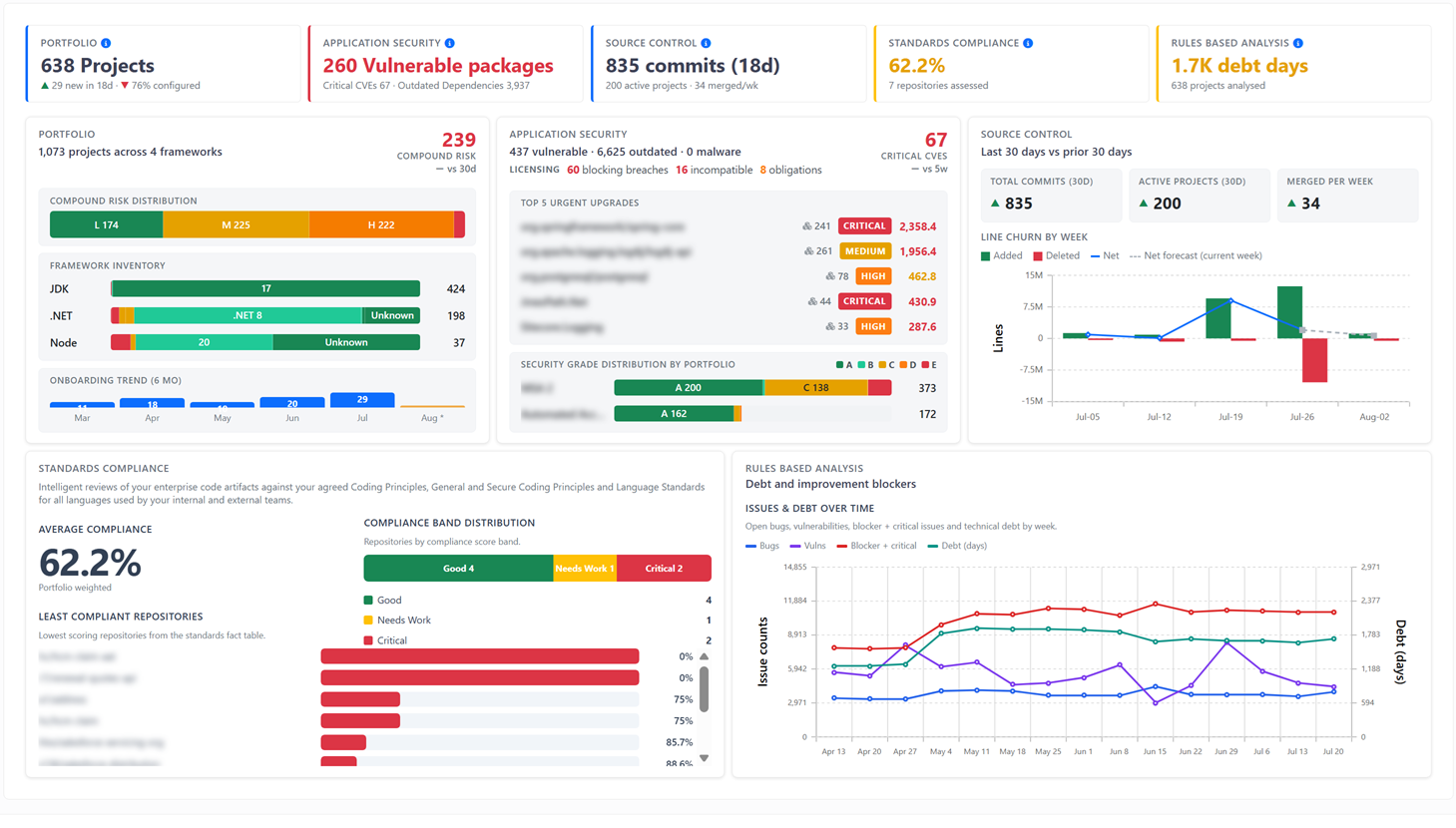
Your whole estate, measured and on one screen
Portfolio risk, application security, source control, standards compliance and rules-based analysis, each opening into its own panel and then into the project that caused it.
Author, enable, review, measure
One platform, four jobs. Your standards are written once, put in front of every agent and reviewer, enforced on every pull request, and reported back to the people who have to answer for them.
Standards & Compliance
Your policies, principles, language and architecture standards in one governed library, with a compliance score you can gate merges on.
- Author once, publish everywhere
- Architecture governed like any other standard
- Baselined score, enforced at the merge
Agentic Enablement
Your standards inside the agent's context before it writes a line, so the code comes back right the first time.
- MCP server, read only
- Claude Code, Codex, VS Code and Cursor
- Findings injected when a file is opened
Reporting & Insights
Estate-wide reporting for engineering, and a strategic view for the people deciding where the agents go next.
- Fifteen reports, all exportable
- Strategic health, risk map, priorities
- Agentic candidates and adoption
Continuous Analysis
The loop that ties it together, running on every commit and every pull request rather than on a schedule.
- Standards into agent context
- Review, then measure
- Insight back into the standards
From a policy you wrote to the code an agent writes
Every finding traces back to a documented language standard, which upholds a principle, which implements a policy. Nothing is enforced that you did not decide.
The golden thread, from policy to compliance score
A six stage chain. A policy sets organisation intent, a principle upholds it, a language standard makes it concrete, that standard is carried into the agent's context as it writes, the pull request is reviewed against it, and the result becomes a compliance score.
- Policy Organisation intent
- Principle General and secure
- Language standard Per-language, with examples
- In the agent's context Delivered before code is written
- Reviewed on the PR Against the same standard
- Compliance score Measured, trended, gated
Where should the agents go next, and is adoption real?
The two questions every engineering leader is being asked about AI, answered from your own estate rather than from a survey.
Agentic Candidates
Every system gets a disposition on two axes, replacement pressure against replacement feasibility, so the rebuild list is argued from evidence rather than enthusiasm.
- Rebuild, Contain, AI-maintain or Maintain
- Readiness banded from strong to not a fit
- Weightings you can set yourself
Agentic Adoption
Adoption measured from signals your organisation controls, never from guessing at writing style, and reported honestly as a floor rather than a headline.
- Observed agent accounts and agreed conventions
- Bots excluded from both sides of the ratio
- Governance and outcomes, not just a count
Hosted, isolated, and run for you
Qualimetry Enterprise is delivered as a managed service in a cloud subscription dedicated to you. There is no shared tenancy, and no platform for your team to operate.
Dedicated cloud
Your own subscription, resource group and virtual network, provisioned and maintained by us.
Dedicated data
Your own database. Your standards, findings and analytics are never co-located with another customer's.
Managed for you
Provisioning, monitoring, upgrades and scaling of the analysis cluster are ours to run, not yours.
Qualimetry Enterprise, answered
What is Qualimetry Enterprise?
How do our standards actually reach a coding agent?
Which languages do you support?
Does this replace human review?
Is Qualimetry hosted, or do we run it?
See Qualimetry on your codebase
Book a demo and we will show you governance, review, reporting and insight running against a real software estate.