 Qualimetry
Enterprise
Qualimetry
Enterprise
Measure compliance, and gate the merge on it
Publishing standards is only half the job. The Compliance Center scores every reviewed file against the pillars that apply to it, rolls that up per project and across the estate, trends it, and gives you a merge gate that enforces the threshold you choose.
Compliance is the average of the pillars you actually measure
A file that contains no security-relevant code should not be marked down for it. Unmeasured pillars are excluded from the average rather than counted as zero, which is why the number stays meaningful as coverage grows.
- Each reviewed file carries a score for every pillar that applies to it.
- A pillar score is the average across the files where that pillar was measured.
- The overall score averages the pillars that have something to say.
- Branches are never collapsed together, so a feature branch cannot flatter main.
Review pillars converging into one compliance score
Each reviewed file is scored against the review pillars that apply to it. In this example 3 were measured and 1 had nothing to measure. The compliance score is the average of the measured pillars only; unmeasured pillars are excluded rather than counted as zero. The resulting score is what the merge gate compares against your minimum.
- Policies POL Measured on this file
- General Principles PRI Measured on this file
- Secure Principles PRINot measured here, so excluded from the average This pillar is excluded from the average rather than counted as zero.
- Language Standards STD Measured on this file
Policies, Principles and Standards, scored separately
The grid shows POL, PRI and STD alongside the overall score, so a project that is strong on language standards but weak on policy cannot hide behind a single average.
Policies
Organisation-level decisions, independent of language.
General Coding Principles
How code should be written anywhere in the estate.
Secure Coding Principles
The security posture every engineer and agent must hold.
Language Standards
Per-language rules, with rationale and worked examples.
Architecture Standards
How systems are structured and how they talk to each other.
Filter it the way you run the business
- Group by your own taxonomy, including repository prefix.
- Filter to baselined, awaiting baseline, or everything.
- Narrow to projects with high-severity issues, or to a single pillar.
- Create project groups so a portfolio owner sees only their own estate.
Start from where you are, not from zero
Turning on standards across a mature estate produces a wall of findings that nobody acts on. Baselining records the current state so the score measures the direction you are travelling rather than the debt you inherited.
- Baseline a project, a group of projects, or the estate in bulk.
- New work is held to the standard immediately.
- Automatic baselining on pull request keeps it current without manual effort.
- The grid shows what is baselined and what is still awaiting it.
A minimum compliance score, enforced where it matters
Compliance that nobody enforces is a report. Compliance wired into the merge is a control. Three independent checks can hold a merge, and you decide which of them your organisation runs.
Compliance merge check
Holds the merge when the change falls below the minimum compliance score you set. The default threshold is 80 out of 100.
AI review merge check
Holds the merge until the AI reviewer has run against your standards and its findings are visible on the pull request.
Human sign-off check
Holds the merge until a person has accepted the findings or marked them false positives. Keeps a human accountable for the decision.
From an estate number to the file that caused it
A score with no path to the cause is an argument waiting to happen. Every project opens into four views that end at a specific file and a specific finding, with the standards actually breached named on the way.
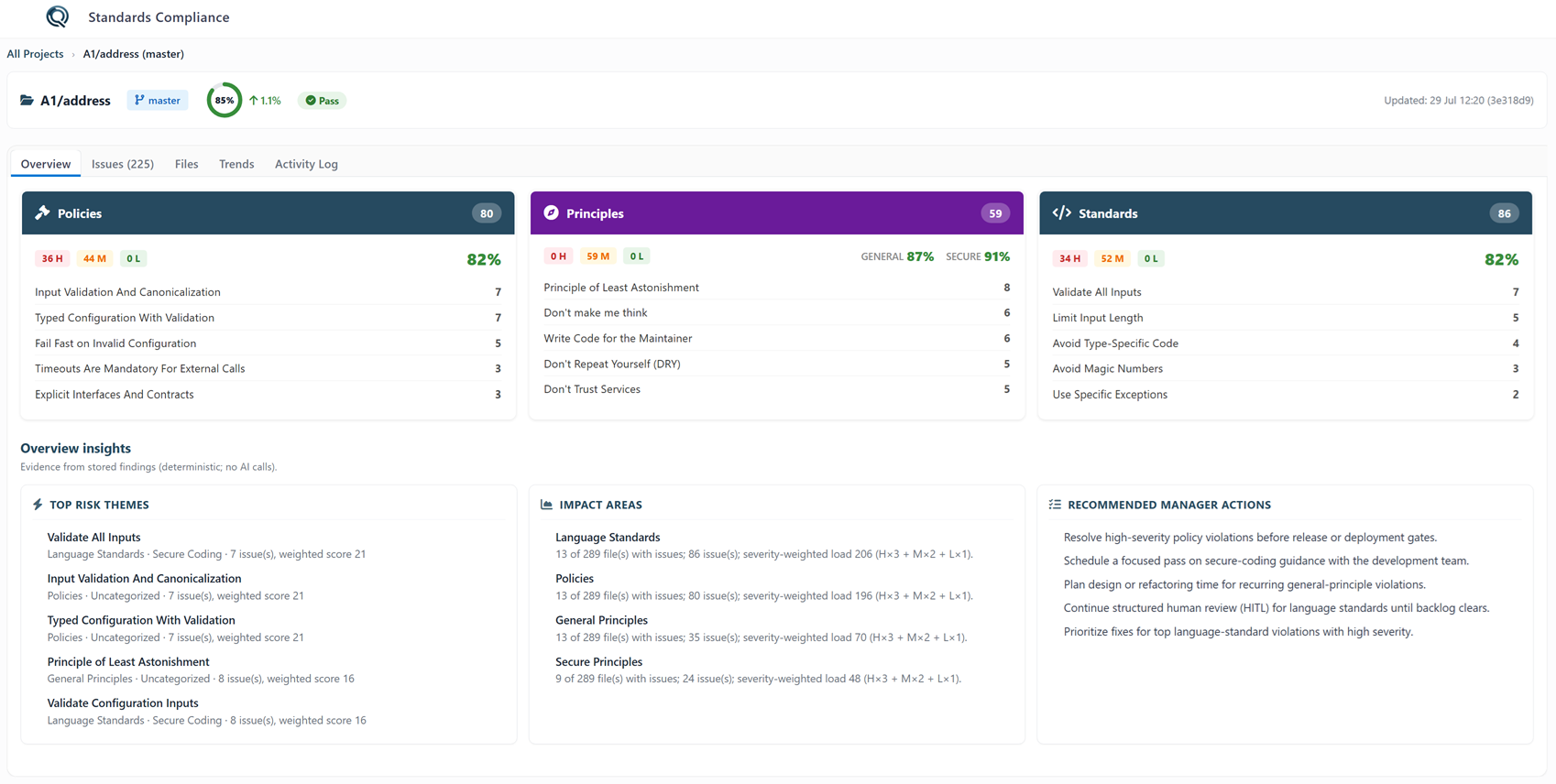
Overview
Pillar cards, top risk themes, impact areas and recommended actions.
Files
File health and an issues explorer, down to the individual finding.
Trends
Compliance, issue counts and files analysed over time, split by pillar.
Activity log
What was analysed, when, and what changed as a result.
The risk themes, impact areas and recommended actions on that overview are computed from the stored findings themselves, not generated by a model, so the same evidence produces the same answer every time it is asked.
This is also where developers get connected
The two buttons that connect an engineer's agent or IDE to Qualimetry live on the page they already use to see their own compliance.
- Get MCP Token issues their access token, without an administrator in the loop.
- Get Agent App hands them the app for the agent they actually run.
Where this sits in Continuous Analysis
None of this works as a separate product. Each stage exists because of the one before it and is only worth doing because of the one after it.
Compliance, answered
How is the compliance score computed?
What happens to a pillar that has nothing to measure?
What is baselining, and why does it matter?
Can we change the threshold the merge gate uses?
See your compliance, measured
Book a demo and see how your estate scores against the standards you would actually publish.